
Your brain is replaying the same conversation for the fourth time today. You are analysing what you said, what they said, what you should have said. You know it is not helpful. You know you are overthinking. But knowing that does not make it stop. If anything, it makes it worse because now you are overthinking about the fact that you are overthinking.
If this sounds familiar, you are not broken. You are experiencing something that has a real psychological explanation, and more importantly, real solutions.
What is actually happening in your brain when you overthink
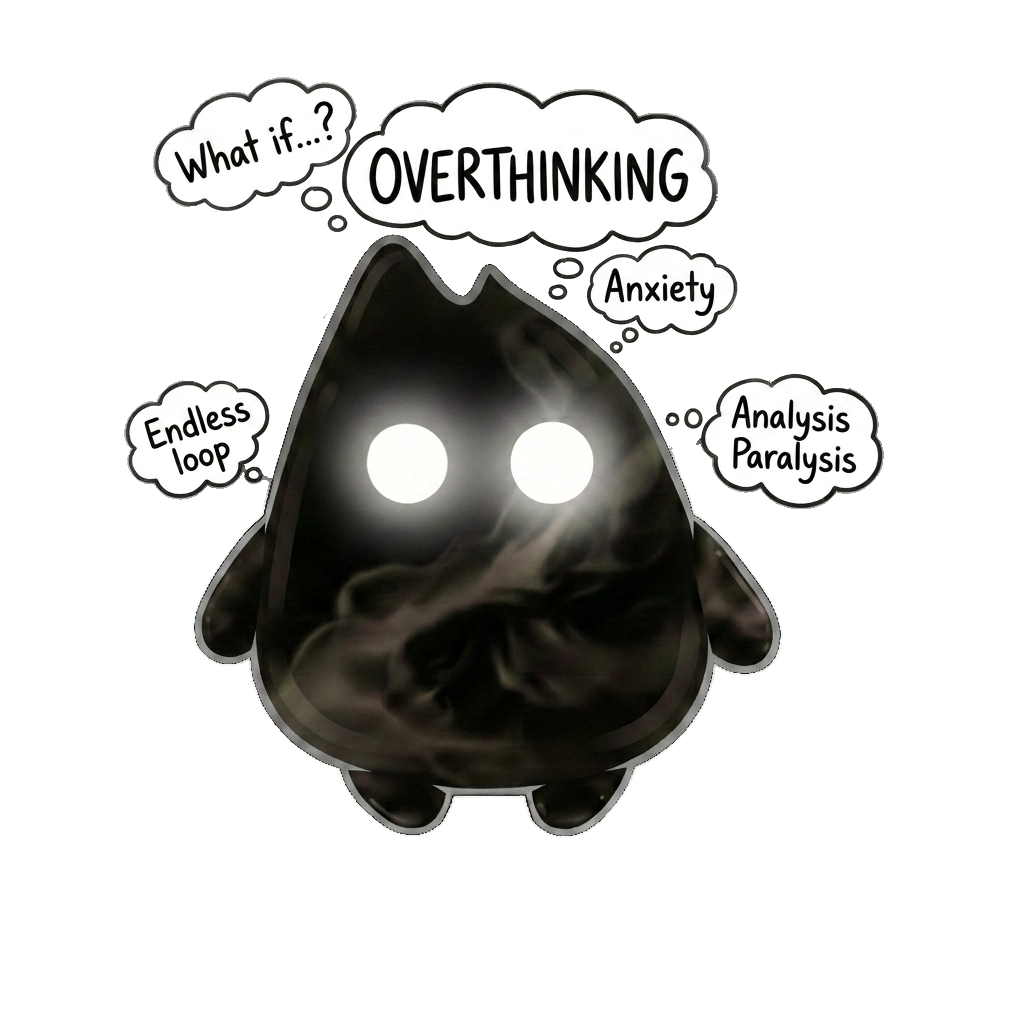
Overthinking is not just "thinking too much." It is a specific cognitive pattern called rumination, and it happens when your brain gets stuck in a loop. Here is the psychology behind it.
Your brain has a built-in threat detection system, centred around the amygdala. Its job is to flag anything that might be dangerous, uncertain, or unresolved. In our evolutionary past, this kept us alive. Today, it flags everything from an awkward text message to an uncertain future.
When the amygdala flags something, your prefrontal cortex tries to "solve" it by thinking it through. The problem is that many modern problems are not solvable through thinking alone. There is no neat resolution. So your brain keeps looping, searching for an answer that does not exist, and this is what we experience as overthinking.
This is sometimes called an amygdala hijack. Your emotional brain has taken the steering wheel from your logical brain, and no amount of analysing will satisfy it because it is not looking for logic. It is looking for safety. If you are curious about how your overthinking patterns work, you can take our free What Type of Overthinker Are You? quiz to find out.
What Kind of Overthinker Are You?
The Ruminator, The Catastrophiser, The Analyser, or The Self-Doubter? Find your type in 2 minutes. Take the quiz →
Why overthinking gets worse at night
If you are someone who lies awake at 2am replaying every interaction from the day, there is a reason for that. During the day, your brain is occupied with tasks, conversations, and stimuli that interrupt the rumination cycle. At night, those distractions disappear. Your brain finally has uninterrupted time to "process" everything it flagged during the day.
Additionally, your prefrontal cortex (the rational, planning part of your brain) is less active when you are tired. This means your emotional brain runs the show unchecked. Everything feels bigger, more catastrophic, more urgent at night because the part of your brain that provides perspective is essentially offline.
Psychology-backed strategies to break the cycle
The good news is that overthinking is a pattern, and patterns can be interrupted. Here are strategies grounded in cognitive psychology and neuroscience that actually work.
1. Externalise your thoughts through journaling
When thoughts stay inside your head, they loop endlessly because your brain treats them as unprocessed. Writing them down is one of the most powerful interventions for rumination. Research on expressive writing shows that externalising thoughts reduces their intensity and frequency. Your brain registers written thoughts as "dealt with" and can let them go.
You do not need to write eloquently. Just get the thoughts out of your head and onto a page. Guided journaling prompts can help if you find it hard to start, because they give your overthinking a direction rather than letting it spiral freely.
2. Practice cognitive defusion
This technique comes from Acceptance and Commitment Therapy (ACT). The idea is simple: instead of engaging with a thought as though it is truth, you observe it as just a thought. You might say to yourself "I notice I am having the thought that everyone is judging me" rather than "everyone is judging me." This small shift creates distance between you and the thought, reducing its emotional charge.
3. Use grounding techniques to interrupt the loop
Overthinking lives in your head. Grounding brings you back to your body and your present moment. The 5-4-3-2-1 technique works well: name 5 things you can see, 4 you can touch, 3 you can hear, 2 you can smell, and 1 you can taste. This forces your brain to shift from abstract rumination to concrete sensory input.
4. Activate your parasympathetic nervous system
Breathing exercises are not just calming. They physiologically shift your nervous system from fight-or-flight (sympathetic) to rest-and-digest (parasympathetic). Understanding which stress survival mode you default to can help you choose the right strategy. Try 4-7-8 breathing: inhale for 4 seconds, hold for 7, exhale for 8. The extended exhale specifically signals safety to your brain. This is not a placebo. It is directly activating the vagus nerve and reducing the cortisol that fuels overthinking.
5. Track your patterns to find your triggers
Overthinking often has patterns that we cannot see when we are in the middle of it. Tracking your moods over time can reveal that your overthinking spikes after certain interactions, at certain times of day, or during specific situations. Once you can see the pattern from the outside, you can intervene before the spiral starts rather than trying to stop it once you are already deep in it.
Putting it all together
The challenge with overthinking is that when you are in the middle of it, you often cannot remember what to do. You know the strategies exist. You have read articles like this one before. But in the moment, your brain is too busy looping to access the solutions.
This is why having your tools accessible in one place matters. InnerPiece was designed around this exact problem. When you are spiralling, you can open the app and immediately access guided journaling to externalise your thoughts, breathing exercises from the wellness toolbox to calm your nervous system, mood tracking to spot your personal triggers over time, and a companion you can talk things through with when you need to process something externally.
It is not about willpower or "just stop thinking about it." It is about having the right tools available at the right time, especially when your brain is too overwhelmed to figure out what it needs on its own.
Key takeaway: Overthinking is your brain's threat detection system stuck in a loop. The most effective interventions work by either interrupting the loop (grounding, breathing), processing the thoughts externally (journaling, talking it through), or building awareness of your patterns over time (mood tracking). You do not need to fix this with willpower. You need the right tools.
Important: If overthinking is severely impacting your ability to function, sleep, or maintain relationships, please reach out to a mental health professional. These strategies are helpful daily tools, but they are not a replacement for professional care. In Australia, call Lifeline on 13 11 14 or Beyond Blue on 1300 22 4636.
Frequently asked questions
Why can't I stop overthinking?
Overthinking is driven by your brain's threat detection system. The amygdala flags unresolved situations as potential threats, and your prefrontal cortex tries to "solve" them by replaying scenarios. This creates a cognitive loop that feels productive but actually keeps you stuck. It is not a character flaw. It is your brain trying to protect you in a way that has become unhelpful.
How do I stop overthinking at night?
Overthinking at night happens because there are fewer distractions to interrupt the loop. Try externalising your thoughts by writing them down before bed. This tells your brain the thoughts are stored safely somewhere and it can let go. Combining this with a breathing exercise like 4-7-8 breathing activates your parasympathetic nervous system and signals safety to your body.
What is the difference between overthinking and anxiety?
Overthinking is a cognitive pattern where you repeatedly analyse situations without reaching resolution. Anxiety is a broader emotional and physiological state that can include overthinking as one of its symptoms. You can overthink without having an anxiety disorder, but chronic overthinking often accompanies anxiety. If overthinking is significantly impacting your daily life, it is worth speaking to a mental health professional.
Does journaling help with overthinking?
Yes. Journaling is one of the most effective strategies for overthinking because it externalises thoughts. When thoughts stay in your head, they loop endlessly. When you write them down, your brain registers them as processed and stored. Research shows that expressive writing reduces intrusive thoughts and helps create cognitive distance from rumination.
Can an app help me stop overthinking?
A well-designed app can provide the tools that help break overthinking patterns, such as guided journaling to externalise thoughts, breathing exercises to calm the nervous system, mood tracking to spot triggers, and a companion to talk things through. The key is having these tools accessible in the moment you need them, not having to remember which strategy to use when you are already stuck in a loop.