
It is 2am. You have been lying in bed for over an hour. Your body is exhausted, but your brain has decided that right now, this exact moment, is the perfect time to replay every awkward thing you have ever said, worry about a deadline that is three weeks away, and reconsider every major life decision you have made since you were sixteen.
You are not broken. You are not uniquely anxious. Your brain is actually doing something very predictable, and there is real neuroscience behind why it happens specifically at night. Once you understand what is going on up there, it gets a lot easier to work with it instead of fighting against it.
Your brain is not malfunctioning. It is switching modes.
During the day, your brain is busy. It is processing conversations, making decisions, responding to notifications, navigating tasks, and dealing with the constant sensory input of being alive in the world. Most of your mental energy goes outward — toward things you can see, hear, and interact with.
But when you climb into bed and the lights go off, something shifts. The external stimulation drops to almost nothing. Your brain, which has been in task mode all day, suddenly has no task. And instead of just... turning off (which is what you desperately want it to do), it turns inward.
This is not a glitch. This is your default mode network activating.
The default mode network: your brain's autopilot for overthinking
The default mode network (DMN) is a network of interconnected brain regions — including the medial prefrontal cortex, the posterior cingulate cortex, and parts of the temporal lobe — that becomes active when you are not focused on the external world. Neuroscientist Marcus Raichle and his colleagues first characterised it in 2001, and it fundamentally changed how we understand the resting brain.
The DMN is responsible for:
- Self-referential thinking (thoughts about you, your identity, your life)
- Replaying past events and conversations
- Imagining future scenarios and potential outcomes
- Processing social interactions and relationships
- Making meaning and connecting dots between experiences
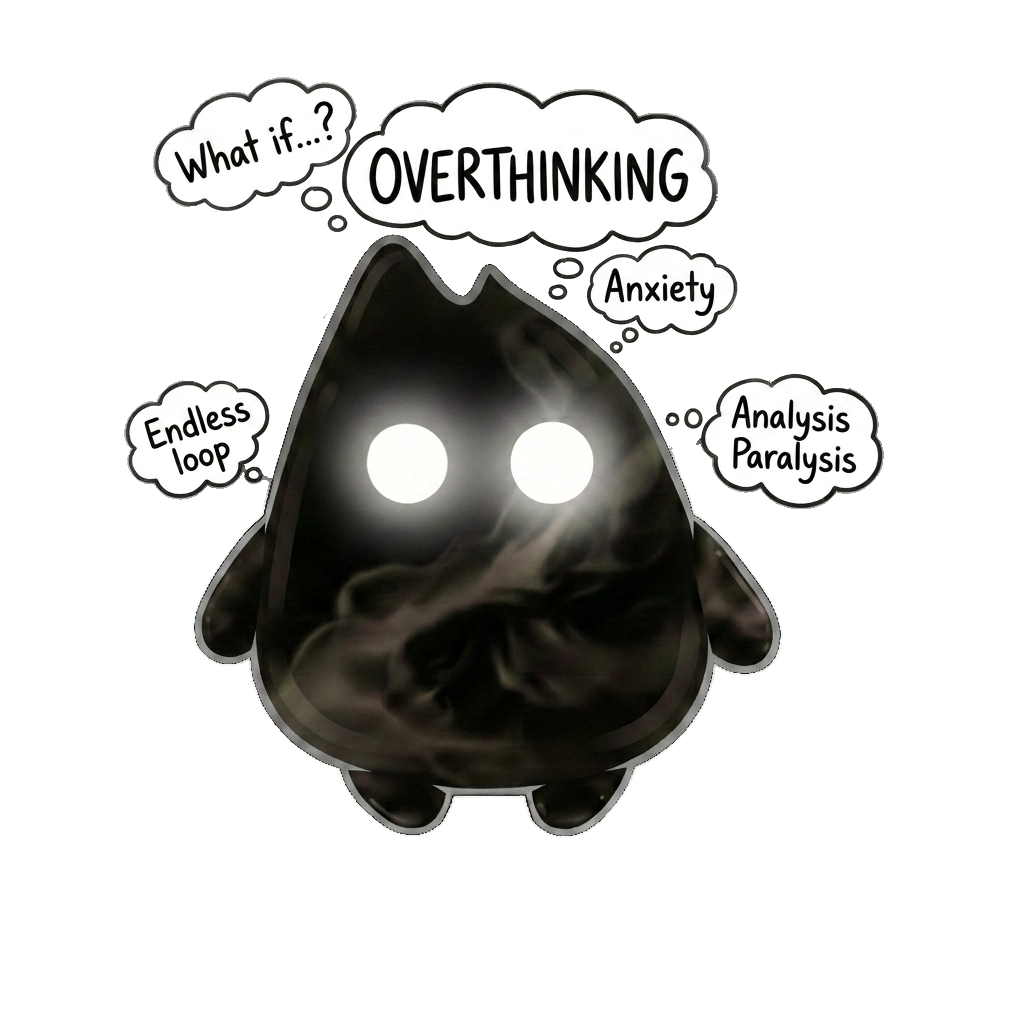
During the day, when you are focused on a task, the DMN quiets down. Your task-positive network takes over. But at night, lying in the dark with nothing to focus on, the DMN fires up with full force. This is why your brain starts replaying that conversation from Tuesday, worrying about whether your friend is upset with you, and catastrophising about your finances — all at once, all uninvited.
Your brain does not overthink at night because something is wrong with you. It overthinks because you have finally stopped giving it something else to do.
The DMN is not inherently bad. It is involved in creativity, planning, empathy, and self-awareness. But when it runs unchecked — especially when you are tired and want to sleep — it can spiral into rumination and anxiety. Understanding that this is a normal pattern of overthinking, not a personal failing, is the first step toward managing it.
The cortisol factor: your stress hormones are not helping
Cortisol, your primary stress hormone, follows a natural daily rhythm called the cortisol awakening response. In a healthy pattern, cortisol peaks about 30 to 45 minutes after waking (helping you feel alert and ready) and gradually declines throughout the day, reaching its lowest point around midnight.
But here is the problem: if you are chronically stressed, under-sleeping, or carrying unprocessed anxiety, your cortisol pattern can become dysregulated. Instead of gently declining in the evening, cortisol can spike or remain elevated at night. Research published in Psychoneuroendocrinology has shown that elevated evening cortisol is associated with increased rumination, difficulty falling asleep, and heightened emotional reactivity.
In practical terms, this means your body is sending alert signals at exactly the time it should be winding down. Your brain interprets this cortisol as a cue that something needs your attention, and since there is nothing external to deal with, it turns that vigilance inward — toward your thoughts, your worries, your unresolved everything.
What Type of Overthinker Are You?
Find out your overthinking style with this free 2-minute quiz. Take the quiz →
Cognitive control declines at night (and that matters more than you think)
Your prefrontal cortex — the part of the brain behind your forehead — is responsible for executive functions like rational thinking, impulse control, emotional regulation, and the ability to redirect your attention. It is essentially the part of your brain that says, "That thought is not helpful right now. Let it go."
The problem is that your prefrontal cortex is like a muscle that fatigues with use. After a full day of making decisions, managing emotions, exercising self-control, and staying focused, it is depleted by evening. This is a well-documented phenomenon in psychology called ego depletion, and while the concept has been debated, the underlying reality is clear: cognitive control is measurably worse at night.
Research from Harvard University has shown that people make poorer decisions, have less emotional regulation, and are worse at inhibiting unwanted thoughts in the late evening compared to the morning. This is why a problem that feels manageable at 10am can feel catastrophic at midnight. Your ability to put thoughts into perspective, to tell yourself "this is not that bad," to redirect your attention away from a spiral — all of that is diminished when your prefrontal cortex is running on empty.
So at night, you have a perfect storm: the DMN is highly active (generating self-focused, ruminative thoughts), cortisol may be elevated (keeping your body in alert mode), and your prefrontal cortex is fatigued (unable to manage or redirect those thoughts). No wonder you cannot stop overthinking.
Why the dark and quiet make it worse
It is not just brain chemistry. The environment itself plays a role. During the day, your sensory system is constantly processing input — sounds, sights, movement, temperature changes, social cues. All of this gives your brain something to orient toward, keeping it externally focused.
At night, lying in a dark, quiet room, that sensory input drops dramatically. Your brain does not just go quiet when the world goes quiet. It fills the silence. Without external anchors, your attention turns inward, and the thoughts that were manageable background noise during the day suddenly become the loudest thing in the room.
This is also why techniques that reintroduce gentle sensory input — like white noise, a guided breathing exercise, or even the physical sensation of a weighted blanket — can be effective at interrupting the overthinking spiral. They give your brain something external to latch onto, reducing the DMN's dominance.
What actually helps: quieting the 2am brain
Now that you understand why your brain does this, here are strategies grounded in neuroscience and psychology that genuinely help.
Do a brain dump before bed. One of the most effective things you can do is get the thoughts out of your head and onto paper (or a screen) before you even get into bed. Write down everything — worries, to-do items, unfinished thoughts, things that bothered you today. A study published in the Journal of Experimental Psychology found that participants who wrote a to-do list before bed fell asleep significantly faster than those who wrote about completed tasks. The mechanism is cognitive offloading: when your brain knows the information is stored somewhere, it stops cycling through it. InnerPiece's journaling feature is built for exactly this. You do not need a prompt. Just dump it all out. Five minutes of messy, unstructured writing can be the difference between lying awake for two hours and falling asleep in twenty minutes.
Use breathing techniques to shift your nervous system. Your autonomic nervous system has two branches: the sympathetic (fight or flight) and the parasympathetic (rest and digest). When you are overthinking, your sympathetic system is dominant. Controlled breathing, specifically techniques where the exhale is longer than the inhale, activates the vagus nerve and shifts you into parasympathetic mode. Try 4-7-8 breathing: inhale for 4 counts, hold for 7, exhale for 8. Or box breathing: 4 counts in, 4 hold, 4 out, 4 hold. These are not woo-woo suggestions. They are physiological interventions that directly lower heart rate and cortisol. InnerPiece's wellness toolbox has guided breathing exercises you can use right from your phone — no need to remember the counts when your brain is already spinning.
Try grounding techniques to interrupt the spiral. Grounding brings your attention from your thoughts back to your physical body and environment. The 5-4-3-2-1 technique is particularly effective: notice 5 things you can feel (the pillow, the sheets, the temperature of the air), 4 things you can hear (even tiny sounds), 3 things you can see (shadows, the outline of furniture), 2 things you can smell, and 1 thing you can taste. This redirects your brain from the DMN toward sensory processing, breaking the rumination loop. You will find grounding exercises like these in InnerPiece's wellness toolbox, designed to be used in the moment when your thoughts feel uncontrollable.
Talk through the racing thoughts. Sometimes the thoughts spiralling at 2am just need somewhere to go. Not everyone has someone they can call at that hour, and even if they do, there is something vulnerable about admitting you are lying awake worrying about something that might sound irrational in daylight. InnerPiece's AI companion is available whenever the thoughts start racing — it can help you talk through what is on your mind, gently challenge catastrophic thinking patterns, and help you process what your brain is trying to work through. It is not about getting advice. It is about not being alone with the spiral.
Track your patterns to find your triggers. Nighttime overthinking is not random. Certain days, situations, or experiences make it worse. Maybe it is worse on Sundays (anticipatory anxiety about the week). Maybe it is worse after social events (replaying conversations). Maybe it is worse when you skip exercise or eat late. Mood tracking helps you spot these patterns so you can intervene earlier. InnerPiece's mood tracking lets you log how you are feeling and start to see the connections between your days and your nights.
Create a wind-down routine your brain can recognise. Your brain relies on cues to transition between states. If you go from scrolling your phone to trying to sleep, you are asking your brain to shift from high stimulation to zero stimulation with no transition. Build a 20-to-30 minute wind-down buffer: dim the lights, do a brain dump journal entry, run through a breathing exercise, put your phone in another room. Over time, your brain starts to recognise these cues as the signal that the day's processing is done. Consistency matters more than perfection here.
Key takeaway: Your brain overthinks at night because your default mode network activates, your cognitive control is depleted, and there is nothing external to anchor your attention. It is not a flaw — it is predictable neuroscience. And once you know why it happens, you can work with your brain instead of against it. A brain dump, a breathing exercise, and a consistent wind-down routine are three of the most effective, evidence-based strategies to quiet the 2am spiral.
If nighttime overthinking is affecting your mornings and mental health, addressing what happens before bed can transform how you start the next day. And if you are feeling stuck in a broader pattern of overthinking and inaction, our guide on feeling stuck in life explores why that happens and what actually helps.
A note on when to seek help: If racing thoughts at night are persistent, distressing, and significantly impacting your ability to function during the day, please speak with a healthcare professional. Chronic insomnia, anxiety disorders, and other conditions can amplify nighttime overthinking, and professional support can make a real difference. If you are in crisis, contact Lifeline on 13 11 14.
Frequently asked questions
Why does my brain overthink at night?
At night, your prefrontal cortex (the part of the brain responsible for rational thinking and impulse control) becomes less active due to mental fatigue. At the same time, your default mode network — the brain's self-referential thinking system — becomes more active when you are not focused on external tasks. This combination means your brain shifts into inward-focused rumination with reduced ability to manage or redirect those thoughts. Cortisol patterns, reduced sensory input, and the absence of daytime distractions all contribute to the overthinking spiral.
What is the default mode network and how does it cause overthinking?
The default mode network (DMN) is a network of brain regions that activates when you are not engaged in a focused external task. It is responsible for self-reflection, replaying past events, imagining future scenarios, and processing social interactions. At night, when external stimulation drops and you lie in a dark, quiet room, the DMN becomes highly active. This is why your brain starts replaying conversations, worrying about tomorrow, or revisiting things that happened years ago. It is not a malfunction — it is your brain doing exactly what it is designed to do when left without a task.
How do I stop racing thoughts before bed?
Effective strategies include doing a brain dump — writing down everything on your mind before bed so your brain feels it has offloaded the information. Breathing exercises like 4-7-8 breathing or box breathing activate your parasympathetic nervous system to calm the stress response. Grounding techniques such as the 5-4-3-2-1 method redirect your attention from internal thoughts to physical sensations. Keeping a consistent wind-down routine signals to your brain that it is time to shift out of problem-solving mode. If racing thoughts persist most nights and significantly impact your sleep, speak with a healthcare professional.
Is it normal to overthink more at night than during the day?
Yes, it is completely normal. During the day, your brain is occupied with tasks, conversations, and sensory input that keep the default mode network in check. At night, those distractions disappear, and your brain naturally shifts to internal processing. Additionally, your prefrontal cortex is fatigued after a full day of decision-making and self-regulation, so your ability to control and redirect thoughts is reduced. Cortisol levels also follow a natural pattern that can increase alertness and anxiety in the late evening for some people. Nighttime overthinking is one of the most commonly reported experiences in psychology.
Can journaling before bed help with overthinking?
Research supports journaling as an effective tool for reducing nighttime overthinking. A study published in the Journal of Experimental Psychology found that writing a to-do list for the next day before bed helped participants fall asleep significantly faster. Expressive journaling, where you write freely about your thoughts and feelings, has also been shown to reduce rumination and anxiety. The key mechanism is cognitive offloading — when you write something down, your brain treats it as processed and stored, reducing the urge to keep cycling through the same thoughts. Even five minutes of unstructured writing before bed can make a noticeable difference.