
If you have ever lain awake at 2am replaying a conversation from three days ago, wondering whether what you said was weird, analysing the other person's tone, and then spiralling into whether you are fundamentally bad at being a human, you have probably asked yourself: is this just overthinking, or is this anxiety?
It is a genuinely important question. And the answer is more nuanced than most people realise. Overthinking and anxiety are closely related, they often show up together, and one can feed into the other. But they are not the same thing. Understanding the difference matters, because it changes how you respond to what is happening in your head, and whether you might need professional support.
Let me break it down as clearly as I can, from a psychology perspective, without clinical jargon that makes you feel like a specimen in a textbook.
What overthinking actually is
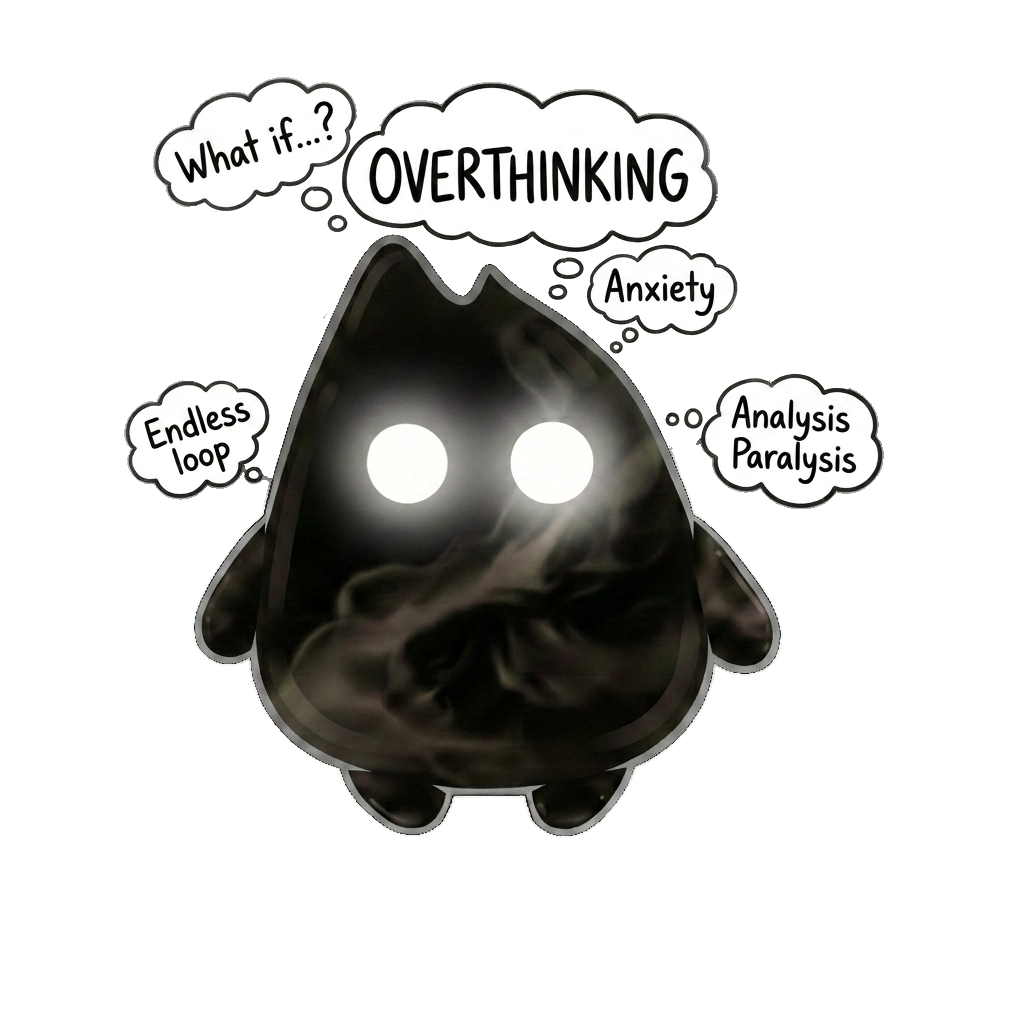
Overthinking is a cognitive pattern. It is what happens when your mind gets stuck in a loop of analysis, replaying, predicting, or evaluating, without reaching any resolution. You think about the same thing over and over, but the thinking does not actually lead anywhere useful. It does not solve the problem. It just exhausts you.
Psychologists generally distinguish between two types of overthinking:
- Rumination — dwelling on the past. Replaying things that already happened, analysing what you said, what they meant, what you should have done differently.
- Worry — fixating on the future. Running through worst-case scenarios, trying to predict and prepare for every possible outcome, even ones that are wildly unlikely.
Everyone overthinks sometimes. Before a job interview, after a difficult conversation, when making a big decision. That is normal and human. The brain is trying to protect you by processing information. The problem is when the processing never stops, when your mind just keeps chewing on the same thoughts without ever spitting them out.
If you want to understand the mechanics of why your brain gets stuck in these loops, our guide on how to stop overthinking goes deeper into the neuroscience behind it.
What Type of Overthinker Are You?
Find out your overthinking pattern with this free 2-minute quiz. Take the quiz →
What anxiety actually is
Anxiety is bigger than overthinking. It is a whole-system response, not just a thinking pattern. When you experience anxiety, your mind and your body are both involved. Your brain's threat-detection system, centred on the amygdala, has decided that something is dangerous, and it activates your fight-or-flight response accordingly.
This means anxiety shows up physically:
- Racing heart, tight chest, shallow breathing
- Muscle tension, especially in the jaw, shoulders, and stomach
- Digestive issues, nausea, or a churning gut
- Difficulty sleeping or staying asleep
- Feeling restless, on edge, or unable to relax
- Fatigue that seems disproportionate to what you have actually done
Clinically, Generalised Anxiety Disorder (GAD) is characterised by excessive, uncontrollable worry about a range of topics that persists for at least six months and causes significant distress or impairment in daily life. But anxiety exists on a spectrum. You do not need a formal diagnosis to be experiencing anxiety that is real, valid, and worth addressing.
The key thing to understand is that anxiety is not just thoughts. It is a physiological state. Your nervous system is activated. Your body genuinely believes it is under threat, even when you are lying safely in bed.
Where they overlap (and why it gets confusing)
Here is where it gets tricky: overthinking is often a feature of anxiety. Many people with anxiety disorders are chronic overthinkers. The worry component of overthinking, running through future scenarios, catastrophising, trying to control outcomes through mental preparation, is essentially the cognitive engine that drives anxious thinking.
But they can also exist independently. You can be an overthinker without having an anxiety disorder. Some people are simply more analytically inclined, more prone to deep processing, and more likely to get stuck in thought loops, without experiencing the physical activation, the avoidance behaviours, or the pervasive dread that characterises clinical anxiety.
Conversely, some forms of anxiety are not particularly cognitive. Panic disorder, for instance, can involve sudden, overwhelming physical symptoms without a clear thought trigger. Social anxiety might show up as intense physical discomfort in social settings, even when your conscious thoughts are not especially catastrophic.
The psychological mechanisms behind each
Overthinking is driven by the default mode network (DMN). This is the brain network that activates when you are not focused on external tasks. It is responsible for self-referential thinking, mental time travel (replaying the past and imagining the future), and making meaning. When your DMN is overactive, it generates more internal chatter than your brain can usefully process, and you get stuck in loops.
Anxiety is driven by the amygdala and the threat-detection system. Your amygdala constantly scans for danger and triggers the fight-or-flight response when it perceives a threat. In anxiety disorders, this system is hypersensitive. It fires in situations that are not genuinely dangerous, sending your body into high alert over social interactions, work emails, or abstract future possibilities.
When both systems are overactive simultaneously, that is when you get the full experience of anxious overthinking: your DMN generates endless worry scenarios, your amygdala treats each one as a real threat, and your body responds with stress hormones, tension, and that horrible feeling of impending doom. It is exhausting, and it is not something you can just "think positive" your way out of.
This is one reason why mental health apps designed for anxiety focus on body-based techniques alongside cognitive ones. You need to address both systems.
How to tell which one you are dealing with
Ask yourself these questions honestly:
Is it mostly in your head, or is your body involved too? If you are going round in mental circles but your body feels relatively calm, that is more likely overthinking. If your thoughts come with a racing heart, tight chest, stomach knots, or muscle tension, anxiety is probably in the mix.
Is it situational or constant? Overthinking tends to be triggered by specific events: a conversation, a decision, an upcoming situation. It usually eases once the situation resolves. Anxiety tends to be more pervasive. It shifts from topic to topic. You resolve one worry and another immediately takes its place. If you have noticed that pattern, our article on feeling stuck vs depression explores how these patterns can overlap with low mood as well.
Can you stop it when you want to? With regular overthinking, distraction or a change of activity usually breaks the loop. With anxiety, the worry feels uncontrollable. You know it is irrational, you want to stop, but you genuinely cannot. That loss of control is one of the hallmarks of clinical anxiety.
Is it affecting your daily life? When overthinking starts causing you to avoid situations, miss deadlines, withdraw from relationships, or lose significant sleep on a regular basis, it has likely crossed into anxiety territory.
Tracking your moods over time can help you see patterns you might miss day-to-day. InnerPiece's mood tracking feature lets you log how you are feeling throughout the week and spot when overthinking escalates into something more persistent, so you have real data rather than just a vague sense that things are getting worse.
What helps with overthinking (that is not yet anxiety)
Give the thoughts somewhere to go. Overthinking loops persist partly because the thoughts have nowhere to land. Journaling breaks the cycle by externalising what is in your head. Once a thought is on paper or on a screen, your brain does not need to keep recycling it. InnerPiece's journaling feature gives you guided prompts when you do not know where to start, which is often the hardest part of getting thoughts out of your head.
Set a thinking deadline. Give yourself a defined window, say ten minutes, to think about the thing that is bothering you. When the time is up, move on. This sounds simplistic, but it works because it gives your brain permission to think without letting it run indefinitely.
Talk it through. Sometimes you just need to hear your thoughts out loud to realise they are not as catastrophic as they seemed inside your head. InnerPiece's AI companion provides a non-judgemental space to talk things through, especially at odd hours when friends and family are not available. It is not therapy, but it can help you process and gain perspective when your mind is going in circles.
Move your body. Physical activity interrupts the default mode network and shifts your brain into a more externally focused state. Even a ten-minute walk can break an overthinking spiral. It does not need to be intense exercise. It just needs to get you out of your head and into your body.
What helps with anxiety (beyond overthinking strategies)
If you are dealing with anxiety rather than plain overthinking, you need strategies that address the body as well as the mind.
Grounding techniques. These work by pulling your nervous system out of fight-or-flight and back into the present moment. The 5-4-3-2-1 technique (five things you can see, four you can hear, three you can touch, two you can smell, one you can taste) is a classic for a reason. InnerPiece's wellness toolbox includes a range of grounding exercises you can access in the moment when anxiety spikes.
Breathing exercises. Slow, extended exhales activate your parasympathetic nervous system and directly counteract the fight-or-flight response. Box breathing (in for four, hold for four, out for four, hold for four) is effective and simple enough to do anywhere.
Professional support. If your anxiety is persistent, uncontrollable, and affecting your daily functioning, please talk to a mental health professional. Cognitive Behavioural Therapy (CBT) is highly effective for anxiety disorders, and medication can also help. There is no shame in needing professional support. Anxiety is one of the most treatable mental health conditions.
For more on what 2am overthinking spirals are really about, read our piece on why you cannot stop overthinking at night.
Key takeaway: Overthinking is a thinking pattern. Anxiety is a whole-body experience. They often travel together, but the distinction matters because it changes what kind of help you need. If your overthinking is situational and manageable, self-help strategies can make a real difference. If it is constant, physical, and uncontrollable, that is your cue to reach out to a professional. Either way, you are not broken. Your brain is just trying to protect you, a little too enthusiastically.
Important: This article is educational content, not a diagnostic tool. It is not a substitute for professional mental health advice. If you think you may be experiencing an anxiety disorder, please speak with a GP or psychologist. If you are in crisis, contact Lifeline on 13 11 14.
Frequently asked questions
Is overthinking the same as anxiety?
No. Overthinking is a cognitive pattern where you repeatedly analyse situations, decisions, or past events without reaching resolution. Anxiety is a broader psychological and physiological response that includes persistent worry, physical symptoms like a racing heart or tight chest, and avoidance behaviours. Overthinking can be a feature of anxiety, but you can overthink without having an anxiety disorder. The key difference is that anxiety involves a body-level threat response, while overthinking is primarily a thinking pattern.
When does overthinking become anxiety?
Overthinking crosses into clinical anxiety when it becomes persistent and uncontrollable, is accompanied by physical symptoms such as muscle tension, sleep disruption, or digestive issues, interferes with your daily functioning at work or in relationships, leads to avoidance of situations or decisions, and has lasted for six months or more. If your overthinking is causing significant distress and you cannot stop it despite wanting to, it is worth speaking with a mental health professional.
How do I know if I have anxiety or just overthink a lot?
Pay attention to whether your overthinking comes with physical symptoms. Anxiety typically shows up in the body as well as the mind. Look for a racing heart, shallow breathing, muscle tension, stomach issues, difficulty sleeping, or feeling on edge. Also notice whether the overthinking is situational or constant. If it is tied to a specific event and passes once the event is resolved, that is more likely regular overthinking. If it persists across situations and feels uncontrollable, that may indicate an anxiety disorder.
Can you stop overthinking without medication?
Many people manage overthinking effectively without medication through strategies like cognitive behavioural techniques, mindfulness, journaling, grounding exercises, and regular physical activity. Tracking your mood patterns can help you identify triggers. However, if overthinking has crossed into clinical anxiety, medication may be a helpful part of treatment alongside therapy. There is no shame in needing medication. The best approach depends on the severity and impact on your daily life, and a mental health professional can help you decide.
Why do I overthink more at night?
Nighttime overthinking is extremely common and has a neurological explanation. During the day, your prefrontal cortex is active and helps regulate emotional responses. At night, as your brain shifts toward rest, this regulatory function weakens while the amygdala, your brain's threat-detection centre, remains active. Without daytime distractions, unresolved worries surface more intensely. This is why thoughts that feel manageable at 2pm can feel catastrophic at 2am. Grounding techniques and a wind-down routine can help reduce nighttime spiralling.